Unemployment: day 9
I visited to South Korea. It was my first time to visit there. In this trip, my purposes are eating Chonggukchan and seeing North Korea.
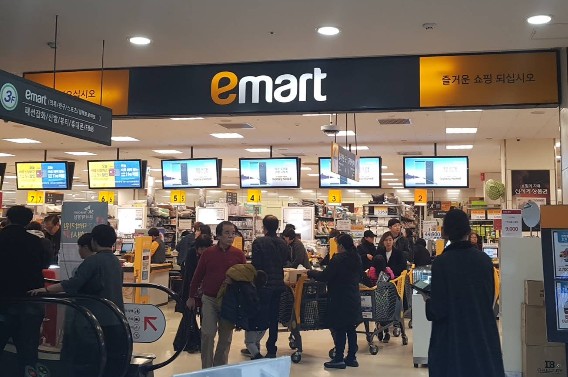
Today was the final day of my trip in South Korea. The departure time of my plain to Japan was at 15:50, I enjoyed shopping souvenirs until noon. I had found the best shop for souvenirs, it was Emart, in my guide book, but it was not in central Seoul. So I went to Wangsimni by subway. Emart was like a minimal size of Target in the US. There were various sorts of groceries, daily necessities, and electric appliances. I bought Korean seaweeds and some candies for my family. The cost was cheaper than buying in central Seoul like Myeongdong.
The final day’s timeline was below.
- 06:00 Woke up and searched for a supermarket to buy souvenirs (Found that LOTTE MART ZETTAPLEX at Seoul Station was closed all day)
- 08:00 Had breakfast included with my stay — toast with kaya jam (Hotel rule: guests must wash their own dishes)
- 08:40 Checked out of the hotel and left my luggage at reception, Went to Emart in Wangsimni
- 09:50 Arrived at Emart and explored souvenir options
- 11:10 Picked up my luggage and headed to Seoul Station
- 12:10 Departed for Incheon International Airport from Seoul Station
- 12:50 Arrived at the airport, checked in, and passed through passport control
- 13:40 Entered the Matina Lounge near Gate 43 and had bibimbap and some side dishes
- 15:30 Boarded the plane, but take-off was delayed until 16:30
- 18:50 Arrived at Narita Airport
References
Correct version
I visited South Korea. It was my first time visiting the country. The purposes of this trip were to try Cheonggukjang and to see North Korea.
Today was the final day of my trip. My flight to Japan was scheduled to depart at 15:50, so I spent the morning shopping for souvenirs. According to my guidebook, the best place to buy souvenirs was Emart, but it wasn’t located in central Seoul. I decided to go to Wangsimni by subway to visit the branch there.
Emart felt like a smaller version of Target in the US. It had a wide range of groceries, household goods, and electronic items. I bought Korean seaweed and some sweets for my family. The prices were much cheaper than those in central Seoul, such as in Myeongdong.
IELTS Improvement Points
Collocation:
“visit a country” / “first time visiting”
→ Correct phrase: no “to” after “visit”. Also, “first time visiting” is better than “first time to visit”.
“scheduled to depart”
→ More formal and accurate than “the departure time was”.
“a wide range of [items]”
→ Useful collocation for describing variety — strong for IELTS Task 1 and 2.
“pick up luggage” / “check in” / “pass through passport control”
→ Standard travel-related collocations; show appropriate vocabulary usage in context.
“household goods” / “electronic items”
→ Natural shopping-related expressions that are common in IELTS Part 2.
Template:
“According to [source], 〜”
→ Great for referencing data, guides, or sources — useful in Writing Task 1 & 2.
“It felt like a smaller version of 〜”
→ Good comparative template for IELTS Speaking to describe similarities.
“The prices were much cheaper than those in 〜”
→ Effective for comparisons; shows use of comparative structure + pronoun substitution (“those”).
Vocabulary:
“souvenirs”
→ Always use instead of “gifts” or “stuff” when describing travel shopping.
“included with my stay”
→ Idiomatic way to describe hotel amenities.
“bibimbap”
→ OK to use as a cultural term if it’s common knowledge or explained.
“self-service rule”
→ You might also describe this as a “policy requiring guests to wash their own dishes”.
“branch”
→ A precise term when talking about a location of a chain store or supermarket.