Unemployment: day 60
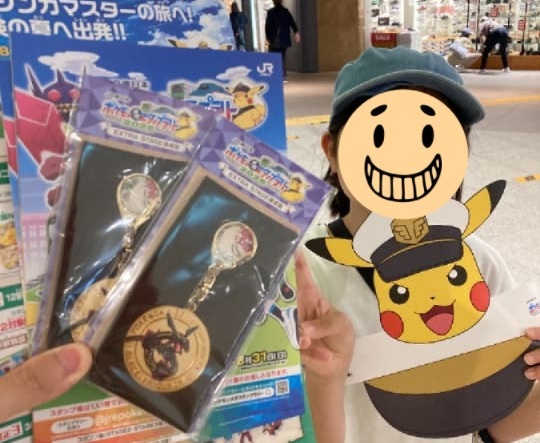
Today, my daughter and I visited to Tokyo station to take rewords about Pokemon stamp rally. We got extra stage rewords – Black Rayquaza Medal -, but can’t get first stage rewords – Pikachu Big Pokemon card -, because it got finished the number of distribution.
After that, we had sushi for lunch at Sushiro. And we purchased a game kit of Hachban-deguchi solving questioners at Tokyo Chuo City Tourist Information Center.
References
Correct version
Today, my daughter and I visited Tokyo Station to collect rewards from the Pokémon stamp rally. We received the extra-stage reward – a Black Rayquaza Medal – but we couldn’t get the first-stage reward – a large Pikachu card – because the distribution had already finished.
Afterwards, we had sushi for lunch at Sushiro, and then we bought a puzzle-solving game kit called Hachiban-deguchi at the Tokyo Chuo City Tourist Information Centre.
IELTS Improvement Points
Collocation:
visit [place] (without to)
→ In English, “visit” is not followed by to. Correct form: “visited Tokyo Station.”
collect rewards / receive rewards
→ Natural collocations for obtaining prizes. “Take rewards” is unnatural in this context.
distribution had finished / sold out
→ More idiomatic than “it got finished the number of distribution.” Shows mastery of aspect and collocation.
have sushi for lunch
→ Common and natural phrasing; “eat sushi for lunch” is fine but less idiomatic.
Template:
We couldn’t [do/get X] because [reason].
→ Useful structure for IELTS Speaking to explain outcomes or experiences clearly.
Afterwards / Later on, [activity].
→ Cohesive device for sequencing events, useful in both IELTS Speaking and Writing.
Vocabulary:
reward vs. prize
→ “Reward” = something you earn by completing a task (e.g., stamp rally). “Prize” = usually won in a competition. Distinguishing the two shows lexical precision.
puzzle-solving / problem-solving kit
→ Clear and natural phrasing for describing an interactive game. “Solving questioners” is unnatural.
Tourist Information Centre
→ Standard British English spelling (centre), useful in travel-related IELTS topics.