
Diary
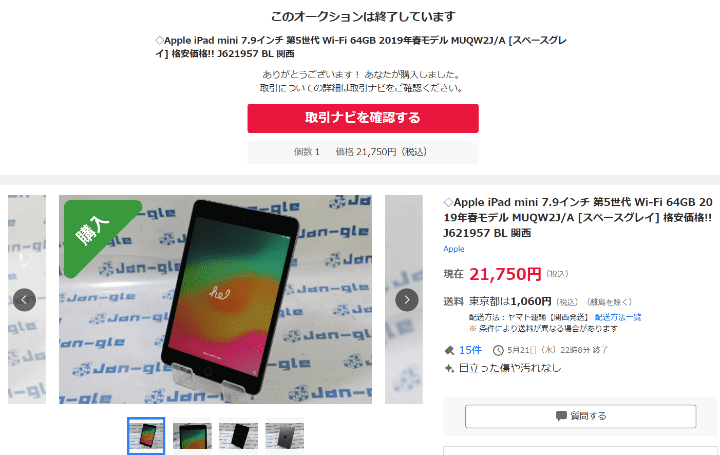
I won a bid for an iPad mini (5th generation) on Yahoo Auction. It cost ¥23,000 including tax and shipping. That was the lowest price on the market for a second-hand iPad mini (5th generation). Guess why I bought it? I had been wanting a second device to use with our AirTags recently. While I’m living abroad, my family aren’t able to check the AirTags. My iPhone is the only Apple device in our home. So although we use the AirTags to track our children’s whereabouts, my wife can’t check their location without my iPhone.
Links
- Airtag
- Apple iPad Mini (5th Generation) Specifications
- How AirTags Help Parents Track Kids’ Location: A Comprehensive Guide
- Mike Tindall Keeps Tabs on His Daughter Mia by Using £35 Apple AirTag Tracking Device
Original statements
I won a bid for iPad mini 5th gen at yahoo auction. It costed 23,000 yen include tax and shipping. The cost was the lowest in market price of second hand iPad mini 5th gen. Guess what I bought it? I had wanted the second device to use our Air tags lately. While I am living abroad, our family are not able to check the Air tags. My iPhone is only device of the Apple product at my home. So we use them to know my children’s whereabouts, my wife can’t check my children’s whereabouts without my iPhone.
Explanation of Corrections
“at yahoo auction” → “on Yahoo Auction”
We use “on” for online platforms in English, especially in British English (e.g. on eBay, on Amazon, on Yahoo Auction).
“iPad mini 5th gen” → “iPad mini (5th generation)”
This is a more formal and readable way to refer to the product, especially in written English.
“It costed 23,000 yen” → “It cost ¥23,000”
The verb “cost” is irregular; its past tense is also “cost”, not “costed” (which is only used in some rare financial contexts).
Also, the “¥” symbol is commonly used when writing about Japanese yen.
“include tax and shipping” → “including tax and shipping”
“Include” is a verb, which doesn’t fit here. You need “including,” which acts as a preposition in this context.
“The cost was the lowest in market price of…” → “That was the lowest price on the market for…”
The correct collocation is “lowest price on the market”.
“In market price” is unidiomatic and incorrect.
“Guess what I bought it?” → “Guess why I bought it?”
The original sentence is grammatically incorrect.
If you want to express the reason for the purchase, “why” should be used instead of “what”.
“I had wanted the second device” → “I had been wanting a second device”
“Had been wanting” (past perfect continuous) expresses an ongoing desire in the past, which fits this context better.
Also, “a second device” is more natural than “the second device”, as it hasn’t been mentioned before.
“to use our Air tags lately” → “to use with our AirTags recently”
“To use with” is grammatically correct when referring to the function of using something in combination with another item.
“AirTags” is a proper noun and should be capitalised and correctly spelled.
“Recently” is preferred over “lately” in this context.
“our family are not able to check” → “my family aren’t able to check”
In British English, “family” is usually treated as a plural noun, so “aren’t” is appropriate.
“My family” is more contextually appropriate than “our” when you’re talking about your own household.
“only device of the Apple product” → “only Apple device”
The original phrasing is awkward and redundant. “Only Apple device” is the clear and natural way to express this.
“we use them to know my children’s whereabouts” → “we use the AirTags to track our children’s whereabouts”
“Track their whereabouts” is the standard and natural phrase in English.
Using “them” was too vague, so replacing it with “the AirTags” makes it clearer.
“my wife can’t check my children’s whereabouts without my iPhone.” → “…without my iPhone.” (revised to use “their location”)
To avoid repetition of “my children’s whereabouts,” it’s better to use a pronoun like “their location,” which keeps the sentence smooth and natural.